Daily Life | Climbing as a Way of Talking to Myself
A note before we start:
More than 90% of my time is in indoor bouldering gyms, a little in indoor top-roping, and I've only been outdoors (for a class) about 2 times...? I'm a little embarrassed about my lack of progress, but since I'm influenced by different forms of climbing, please allow me to still call it "climbing" in the title.
I've now been climbing for over 5 years. About two years ago I wrote down how climbing taught me that "I am who I am, existing has nothing to do with right or wrong, and I don't need to live by other people's standards". This time I want to record some new feelings.
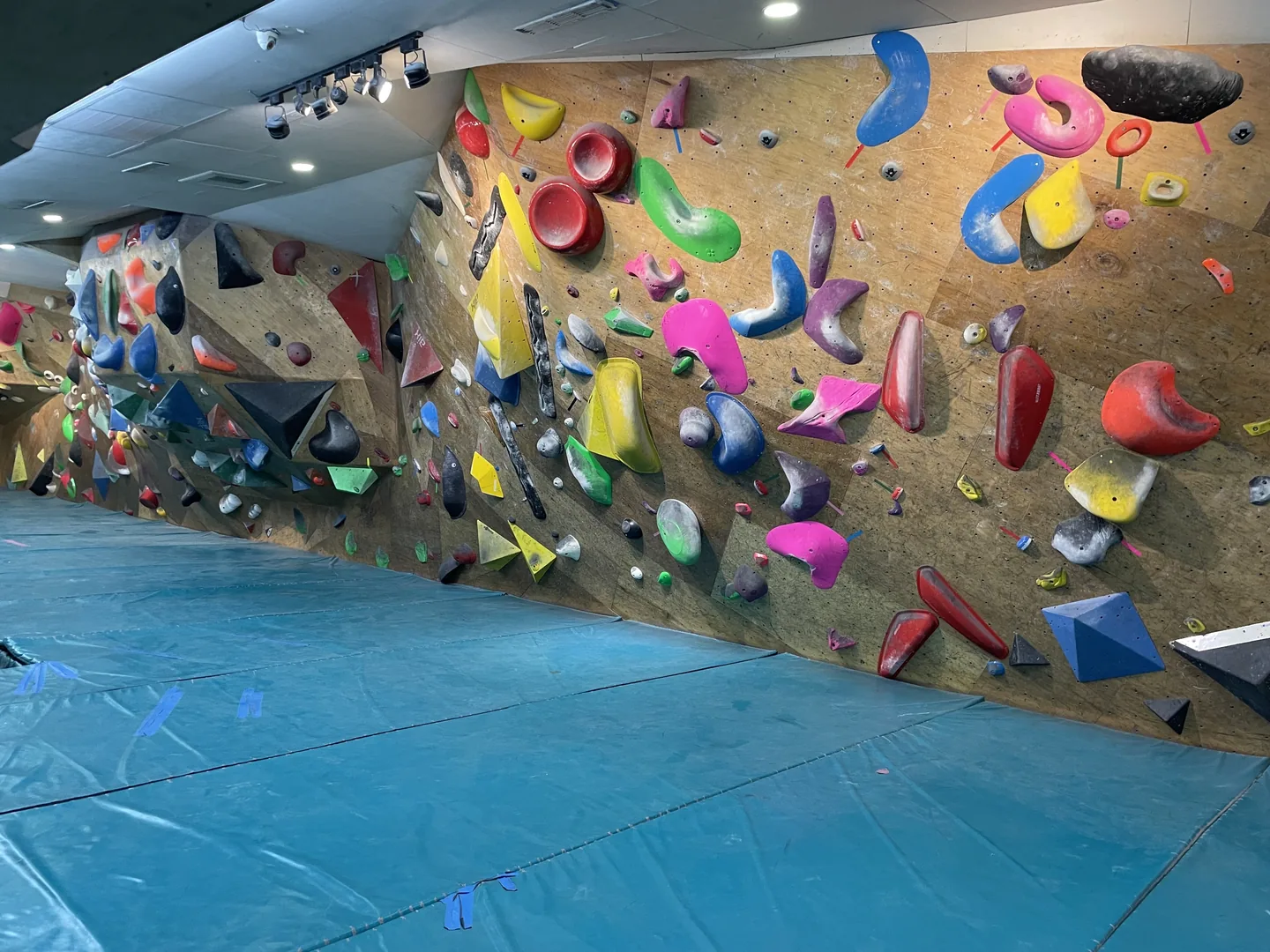
A moment where you can safely practise failing and grow slowly
At first I started bouldering just because it was fun, with no goals.
In my busy life, my most satisfying state was climbing twice a week: enough to improve a little and still leave time for other hobbies. But because of studies, work, the pandemic, and my shoulders, knees, wrists and other parts getting hurt in turn even though I was already careful, there were also times when I climbed once a week, or once a month.
"Climbing can be a way to relieve stress and gives you an endless sense of achievement."...?
This is definitely the biggest misjudgement! Maybe after climbing twice a week without a break for two months, you start having magical moments of "I improved again compared to last time!" over and over, but before long you realise that most of the time climbing hovers between "frustration and failure" and "endless starting over". The growth curve doesn't go up all the way (↗) but goes up and down like a wave (〰️), unpredictably.
That sounds terrible, and you might even want to equate it with the embarrassing episodes in life you don't want to remember, or with failing to finish a route, or with training hell. In fact, it's an excellent situation where you can fail safely, practise endlessly, debug and learn by trial and error. There's no pressure from a superior grading your performance, no competition or little tricks between colleagues, no exclusion or scheming among peers, so you can put all your attention on yourself. Voilà! Wonderful! And everyone around is an angel, happy to share methods and techniques, cheer loudly for your brave attempts, or be purely delighted when you complete a route.
It took me a year and a half to climb V3, and another year and a half to move up to V4. Next to me there are plenty of people who reach V4 within a year, so compared to them I'm well qualified to say I grow slowly. But slow progress doesn't mean slacking off. There's a lot to work on: top rope, leading, technique, reading routes, footwork, strength and endurance training... feeling your breath, the muscles filling with blood, the shifting of your centre of gravity, the friction on your fingertips, and of course learning how to apply force correctly when injured and all kinds of knowledge about the body.
The conversation you hear most at a climbing gym:
A: "I can't do this one."
B: "You can!"
Taking my friend L's devastating injury (?) as a warning (though L never stops climbing because of injuries...), I've always climbed in a laid-back way (at least I think so), not obsessed with moving up in "grades" themselves (I still get happy when I do), but breaking down all the important elements of getting stronger and building them up one by one. Even now, before bouldering I still do a 10-minute warm-up and a 10-minute traverse, and climb all the V0s and V1s (this warm-up menu may still be a bit lazy... sweat). I also don't try the same project route too many times (it wears out the same body parts), and I refuse all kinds of risks with an "I'm just bad" spirit. As a result, I climb dynamic routes terribly, underestimate my own ability, and sometimes after egging myself on to try a route I "really can't do", I complete it. Anyway, my grades are occasionally a mess, and my climbing buddies see me as a big bluffer.
Climbing is a mirror: you can look bravely, or turn away
Across countless attempts, everything you challenge is about yourself: your ability, your fears, your weakness, all the physical or mental things you don't want to admit or can't get past. Here you can try bravely, but it's also fine to choose to give up.
Just like my "laid-back" attitude is often an excuse for avoiding problems. For example, I avoid dynamic routes "for fear of injury", but what I'm actually afraid of is stepping out of my comfort zone to learn new things and new sensations, and the frustration that is bound to come with learning. I can avoid it again and again, but the problem will come back again and again, and it's never too late to be brave once on the day I think "I seem to be in good shape today".
[System] You've encountered a dynamic route. What will you do?
▶ Fight
▶ Run
▶ ...Next time
After I found this pattern in climbing, "I can choose to be brave, I can choose to avoid, I can choose to avoid now and be brave later when I want to", I seemed to be able to face all kinds of conflicts and setbacks in life calmly. For example, when I'm asked to behave against my personality or values, or can't communicate smoothly with a partner, I can choose to adjust myself as if acting (?), or learn other communication skills to start a conversation, but I can also choose not to cooperate and not to compromise, and bravely choose "No! No means no!"
Perhaps climbing foretells that "some things I can't do now, I'll still run into later", but at the same time it reminds me to accept the "I just don't want to right now" me, with no need to feel guilty about the choice, let alone blame myself.
What returns isn't only the body, but a way of living
To perform better on the wall and avoid injury, you can't act on instinct alone, so the body, which I used to use unconsciously and take for granted, became the focus of attention. Practising sensing how every small part of the body works, recognising the nature of fear and weakness, and using all four limbs on the wall feels like getting our animal side back.
Civilisation takes us further and further from our bodies, and further from nature. With technology we can go anywhere and no longer need to rely on our feet to move. We can do many things staying inside comfortable and safe man-made buildings. People's lives are easily cut off from nature (or keep only "the parts they think are good"), and the body is often left with only looping labour.
This process of getting my body back made it so that I, someone reduced to a useful and efficient part in the great wheel of society, no longer accept the fucking system of "working hard for a better life", no longer want to sacrifice my health and cause permanent damage for work and then use the money I earn to see a doctor. I'm not a professional climber, but when work damages my body and mind more than climbing injuries do, it's a reminder that I should stop and think. (And work takes up as much as 1/3 of the day!)
As a human, I should, and deserve to, have a better self and a better life. That's what I think.
People were created to be loved, things were created to be used. The reason why the world is in chaos is because things are being loved, and people are being used.
— translated from 空屋筆記-免費的自由 (in Chinese)
(Although this passage has drifted from its original meaning through repeated quotation, I still like this version.)
Making a choice means deciding what to gain and what to lose
The calluses on your fingers get soft again after two months of not climbing, but the thickened heels and deformed toes from being curled up in climbing shoes for a long time are almost irreversible. Not long ago, because of a trip abroad and catching COVID, I didn't climb for 4 months. Looking at the usual calluses on my toe joints and the non-congenital bunion on my big toe, I realised: "If I see my body as something sacred and inviolable, but I'm willing to let my toes deform and my body get hurt again and again to keep going, then climbing must be an important choice in my life, right?" I've put in time, money and energy, endured pain and mental torment, and even changed the rules of my life and the order of what matters. (Mental torment: for example, when you're top-roping and your belayer would rather let you "take" for a long time and keep going up than lower you down QQ)
Making choices has always been hard for me. I'm afraid of the sunk cost of choosing wrong, of being unable to choose again and stuck, of losing freedom, of having to compromise, yet I know I don't yet know what I want, so I can only keep trying and crossing off what I don't want one by one. As I get older, I seem to be coming to a stage where I can't try things so freely any more, just as when the difficulty of a route rises, the room to adjust your movement gets smaller, and a tiny difference decides whether you get through the crux. So I've realised that the choices I make right now can't be brushed off, and lately I've become much more careful...
This is a big task for me, but with all kinds of experience piling up and knowing myself better, I can also feel my direction and goals steadily and clearly narrowing down. I'm not always this harsh on myself though; there are still slacking-off moments of "all roads lead to Rome" when I don't want to choose.
Some time ago I picked up the habit of playing the piano again, practising moving to the right chord without looking at my left hand, which is a lot like practising dynamic moves in bouldering. Watching my left hand change chords is like staring at my feet while moving. If you want to improve, you have to find the position with your eyes and remember it with your body: think about the distance between holds, how far and how high to step, and practise over and over. Still, a wrong position on the piano just makes a dissonant note, while in bouldering a dynamic move might mean missing the foothold and twisting a hand. Fear and risk aren't in the same league!