Work Exchange: An Oyster Fishing Village on Kumihama Bay, Kyotango
My third work exchange was in Kyoto Prefecture... at the northernmost point, facing the Sea of Japan! It was the second most remote place I've done a work exchange (though at the time it was the number one). The house is 3 km from the nearest station (Kotenbashi Station on the Tango Railway) and 6 km from a convenience store or supermarket. It's remote, but I didn't find it that inconvenient: the host would drive us to the supermarket for shopping, and I was pretty carefree with a bicycle.
Living at an oyster farmer's home: host Atsushi-san
I stayed here for three weeks. Host Atsushi-san is a third-generation oyster farmer on Kumihama Bay, and you step out of the back door of the house and you're at the sea. Every house has its own pier for a work boat, and the oyster rafts sit in the middle of a lagoon, five minutes away by boat.
He also runs a two-story guesthouse with three rooms in total, which his grandmother started. There are quite a few family-run guesthouses like this in the area, and the guests are mostly Japanese people who come in autumn and winter for the matsuba crab, whose season has just opened, and for Kumihama Bay oysters. Atsushi-san speaks very good English, so during my stay one or two groups of foreign guests stayed too.
Work with no fixed content
Work here started at 9 every day and ended before noon, with no fixed content, and often I only found out what the day's job was once I got there. For example: making sandbags and pushing them into the sea as boat anchors, organizing the boxes of bird clams (torigai) on the oyster rafts, sorting oyster babies, guesthouse cleaning, making beds and serving meals (I was even surprised with a tip of a 1,000-yen note wrapped in tissue paper, and apparently tipping servers used to be quite common in the old days), tidying the storage room, the kitchen fridge, and so on.
The work was varied and mostly easy, and I could do it at my own pace. Even organizing the kitchen was something that I and the other work exchange guest, Samuel from France (he's a baker, and we had lots of opinions about the state of the kitchen XD), suggested doing.
It didn't feel like work here. It felt much more like really being on holiday in a seaside fishing village, and going on an overnight trip was totally fine too. The short hours are a key factor, but a lot of the credit goes to Atsushi-san. He's a gentle person, never stingy about responding to what we needed, works almost alongside us, and treated us like friends.
Oyster and Tango torigai farming on Kumihama Bay
Kumihama Bay is a lagoon on the Sea of Japan coast, and its "oyster farming landscape" was designated a Kyoto Prefecture cultural landscape. The main oyster farming method is to drill holes in scallop shells with lots of baby oysters attached, fix them at intervals on a rope, and hang them vertically under the water from a raft, where they feed on plankton.
My host's family uses a newer method, "single seed basket farming". Each baby oyster is separate, and they're put together into a roomy, mansion-like net basket and hung in the sea. They don't crowd each other's growing space, and when the waves knock them together, the growth rings on their edges get worn off, so the shell thickens in a concentrated way and can form a deep cup inside. The yield is relatively low, but the size is uniform and the shape is beautiful, and it's made only for the top-end raw market.
What I got to experience was this: the oyster babies, only three weeks old and recently bought, come in big and small sizes, and I helped separate them by size so the big ones don't take the food and starve the small ones.
Generally, oysters start being raised in spring and are harvested in winter. The reason they started in November here is that the water is colder then and harmful fouling organisms have almost stopped reproducing, so the oysters survive better. Growth is slower in winter, but growing up in the cold and the wind and waves builds a strong body!
The rafts used for oysters here also raise "Tango torigai" (Tango bird clams), of which there are very few similar species in Taiwan, and the info says it's Japan's top-grade bird clam brand. They're also sunk into the sea by hanging, but loaded a bit differently: in basket-like containers with sand they can burrow into, and the opening is fitted with a grill-like net cover to keep out predators, while the tasty plankton still gets in~ (The summer of 2025 was so hot that the Tango torigai in Kumihama Bay were wiped out entirely 🥲)
Biking around aimlessly
Here, biking around aimlessly was what I did most. I loved looking for unstaffed farm stands, tasting local produce, and enjoying the autumn scenery, sunrises and sunsets of a fishing village in the countryside. For farther trips, I biked 50 minutes to Kumihama Station, or took the train to nearby Toyooka, Amino and Mineyama, and I also went to Kinosaki Onsen and Amanohashidate, one of Japan's Three Views.
None of these places is more than a 30-minute drive away, and most aren't famous sights, but I really like spending a day or an afternoon picking a few little-known landmarks or restaurants I want to eat at as destinations, then enjoying the surprise detours and unexpected views along the way.
The bike ride I remember most
The image that stayed with me most in Kyotango was one bike ride.
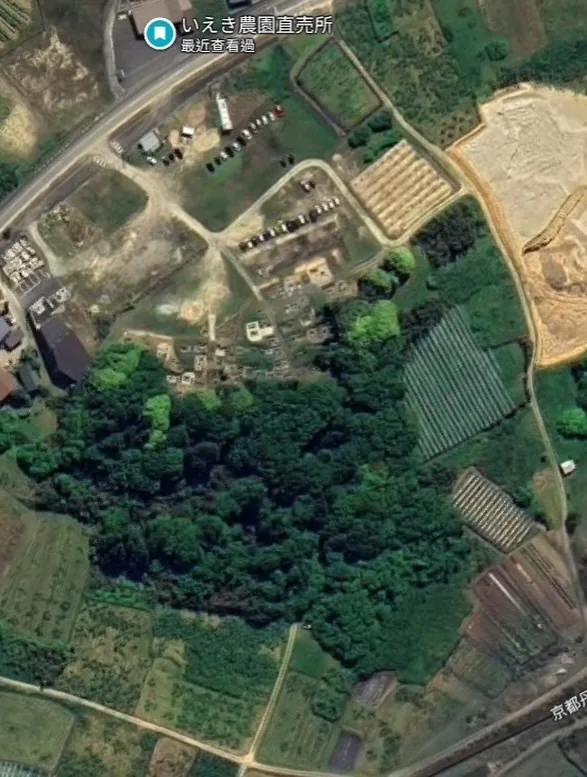
First I rode along a slightly winding concrete path with fruit trees on both sides. Then the same path turned from concrete to grass, with two bare tracks worn by cars, and my bike wheels reluctantly pushed on across the bumpy grass. In the distance was no longer an orchard but a small stretch of woods. The woods section was short and I could see the sky at the exit, so I wasn't scared at all (okay, maybe 10% scared).
But after less than twenty meters, a steep uphill appeared that my 3-speed city bike couldn't conquer, and after I got off and pushed for five or six meters, I saw a super long downhill that made me cheer (and on smooth concrete, too). I happily coasted down, enjoying the suddenly open view and the wind on my face. Then on my right appeared at least 30 little Jizo statues in tiny red caps and bibs, lined up like a choir, with neat rows of gravestones stretching out on both sides.
"Eh? Eh?" I didn't know whether I should brake. Speeding along so happily felt kind of disrespectful, so I ended up squeezing and releasing the brakes guiltily. At the bottom of the slope was a big paved farm road, and the farm stand was diagonally across, back to reality (?). In just a few minutes I felt a complicated change of feelings, truly unforgettable.
Thank you for all the care and the conversations!
Further reading: 〈A Working Holiday Year in Japan: Preparation, Costs, and a Life That Isn't Mostly Working〉 (2026-08-31)
KeywordsKyotoKyotangoKumihama BayKotenbashiwork exchangeoystersoyster farmingTango torigai